
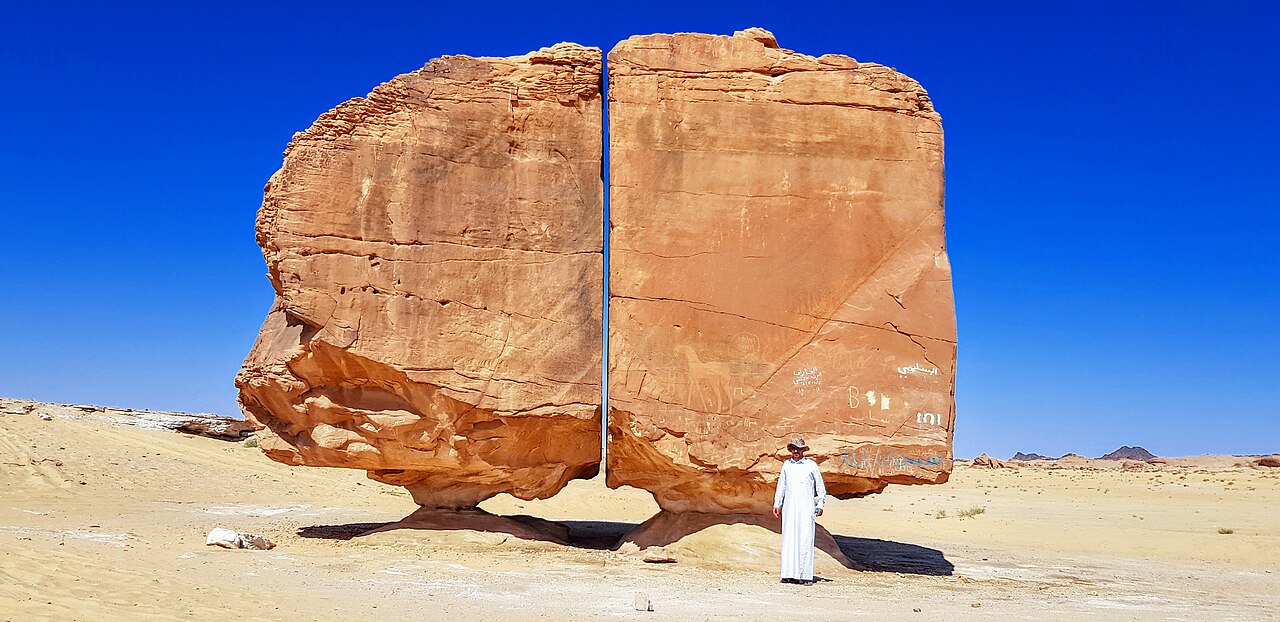
Al Naslaa Rock is one of the most intriguing natural formations in the Arabian Peninsula. Located in the Tayma Oasis region of northwestern Saudi Arabia (about 391 km north of the city of Medina), this remarkable sandstone structure has gained international attention for its striking appearance: a massive boulder split cleanly down the middle, as if cut with a precision tool. Resting on two narrow pedestals, the rock appears both perfectly balanced and mysteriously divided, prompting curiosity, scientific inquiry, and widespread speculation.
Geographic and Historical Context
Al Naslaa Rock lies near the ancient oasis town of Tayma, an area known for its long history of human settlement. Tayma has been inhabited for thousands of years and was an important stop along historic trade routes connecting the Arabian Peninsula with Mesopotamia and the Levant. The region contains numerous archaeological artifacts, including rock carvings, inscriptions, and remnants of ancient civilizations, situating Al Naslaa within a broader landscape of cultural and historical significance.
Physical Characteristics
The most striking feature of Al Naslaa Rock is its near-perfect vertical split. Each half of the rock stands several meters tall and rests on a small base, giving the illusion that the upper mass is delicately balanced. The flatness and symmetry of the split are highly unusual in natural rock formations, especially in sandstone, which typically erodes irregularly.
In addition to the split, the rock surface bears ancient petroglyphs—carvings believed to depict human figures, animals, and symbols. These engravings suggest that the rock held cultural or symbolic importance for ancient peoples who lived in or passed through the area.

Scientific Explanations
Geologists generally attribute the formation of Al Naslaa Rock to natural geological processes rather than human intervention. The prevailing theory is that the split resulted from a combination of natural fracturing and long-term erosion. Sandstone commonly develops joints or fractures due to tectonic stress, temperature fluctuations, or the gradual release of pressure as overlying material erodes away.
Once a natural fracture formed, wind erosion—particularly powerful in desert environments—likely widened and smoothed the split over thousands of years. The consistent wind patterns and abrasive sand particles in the region could plausibly account for the remarkably straight division seen today.
Speculation and Popular Theories
Despite scientific explanations, Al Naslaa Rock has inspired numerous alternative theories. Some have speculated about ancient advanced civilizations, lost technologies, or even extraterrestrial involvement due to the apparent precision of the split. While such ideas capture public imagination and contribute to the rock’s popularity on social media, they are not supported by empirical evidence.
Nevertheless, these narratives highlight the human tendency to seek meaning and mystery in unusual natural phenomena, particularly when they challenge expectations of how nature typically behaves.
Cultural and Tourism Significance
In recent years, Al Naslaa Rock has become a notable destination for tourists, photographers, and researchers. As Saudi Arabia expands its cultural tourism initiatives, the site has been promoted as part of the country’s rich natural and historical heritage. Visitors are drawn not only by the rock’s unusual appearance but also by the surrounding desert landscape, which offers a striking sense of scale, isolation, and timelessness.
Find All Saudi Arabia Tours & Excursions >>
Al Naslaa Rock stands as a compelling example of how natural geological processes can produce forms that appear almost artificial. Whether viewed through the lens of science, history, or imagination, the rock remains a powerful symbol of the desert’s capacity to surprise and inspire. Its clean split, ancient carvings, and remote setting ensure that Al Naslaa will continue to fascinate scholars and visitors alike for generations to come.